


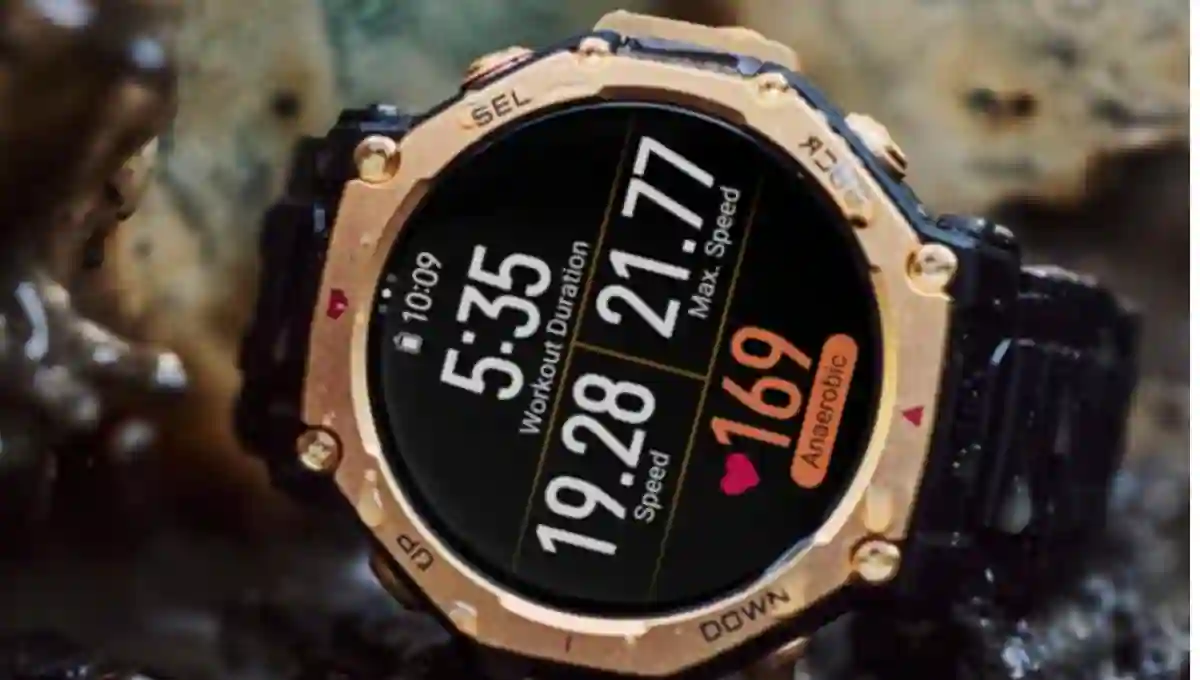
After testing it on real trails — from muddy forest loops to sub-zero ridgelines — here is everything you need to decide if the T-Rex 3 Pro beats the Garmin at half the price.
Garmin has dominated the rugged smartwatch market for years. Fenix 8 — $900. Epix Pro — $1,000. The assumption has always been: if you want a serious outdoor watch, you pay the serious price.
The Amazfit T-Rex 3 Pro wants to challenge that assumption — hard. At $400, it brings a titanium body, sapphire glass, downloadable offline maps, a dual-color LED flashlight, and a claimed 19-day battery to the table. That is a lot of watch for the money. But is it enough watch?
I have been running this thing on trails, in rain, in the cold, and through a full firmware update cycle (including the Zepp OS battery drain drama that hit T-Rex 3 owners hard in mid-2026). This is my honest verdict — with zero fluff.
Who this review covers: The Amazfit T-Rex 3 Pro (48mm, $400). Not to be confused with the standard T-Rex 3 ($280) — I cover the key differences between the two in their full comparison. If you are undecided between the two, jump to the T-Rex 3 vs Pro section below before reading the full review.
- Buy if you hike, trail run, ski, or fish and want Garmin-tier hardware at half the Garmin price.
- Buy if the built-in flashlight, offline maps, and exceptional GPS endurance matter to your adventures.
- Skip if you need Spotify, Garmin Connect ecosystem, or NFC payments on your wrist.
- Skip if you want a lightweight daily smartwatch rather than a rugged outdoor tool.
Full Specs at a Glance
| Specification | Amazfit T-Rex 3 Pro (48mm) |
|---|---|
| Price | $399.99 (44mm available at $369.99) |
| Display | 1.5-inch AMOLED, 2,000 nits, 480×480 |
| Build Material | Titanium bezel & buttons, Sapphire crystal glass |
| Durability | Military-grade MIL-STD-810H, 10 ATM water resistance, -30°C to 55°C operating range |
| GPS | Dual-band L1+L5, supports GPS, GLONASS, BeiDou, Galileo, QZSS |
| Battery — Daily Use | 19 days (typical), 22 days (light use) |
| Battery — GPS Modes | 29 hr (precision), 114 hr (long battery GPS), 180 hr (GPS Max) |
| Flashlight | Dual-color LED (white + red), 3 brightness levels, SOS strobe mode |
| Navigation & Maps | Offline downloadable maps, ski resort maps, Komoot integration, Zepp route planning, contour maps |
| Sports Modes | 180+ (including skiing, fishing, dog walking, open water swimming) |
| Smart Features | Built-in mic + speaker, Bluetooth calling, voice assistant, Zepp Coach AI training |
| Health Sensors | BioTracker 6.0 PPG, SpO2, stress, sleep, BioCharge energy tracking |
| OS | Zepp OS 5.0 |
| Sizes | 44mm & 48mm |
Build Quality & Design: Where Amazfit Got Serious
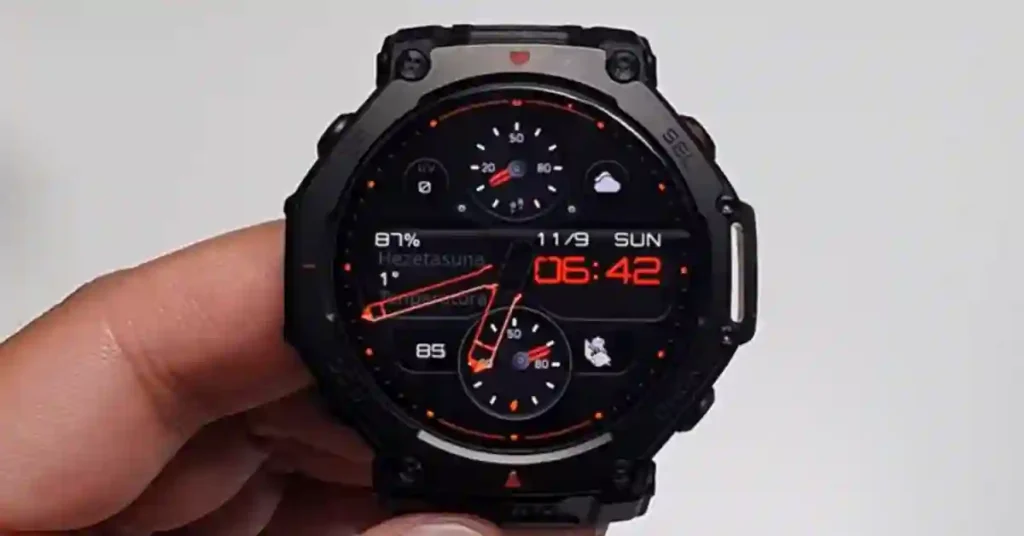
Pick up the T-Rex 3 Pro and the first thing you notice is the weight. At 64g (without strap), it sits noticeably heavier than a standard fitness watch — but lighter than you might expect from a watch with a titanium chassis.
That titanium bezel is not just a marketing word. Combined with the sapphire crystal face, the Pro is meaningfully tougher than the standard T-Rex 3’s stainless steel and tempered glass construction.
Military-grade MIL-STD-810H certification means it has been tested against shock, extreme heat, humidity, salt fog, and altitude. The -30°C cold resistance is the spec that actually matters if you ski or mountaineer. I wore this at altitude in January — it did not miss a beat.
The Flashlight: More Useful Than You Expect
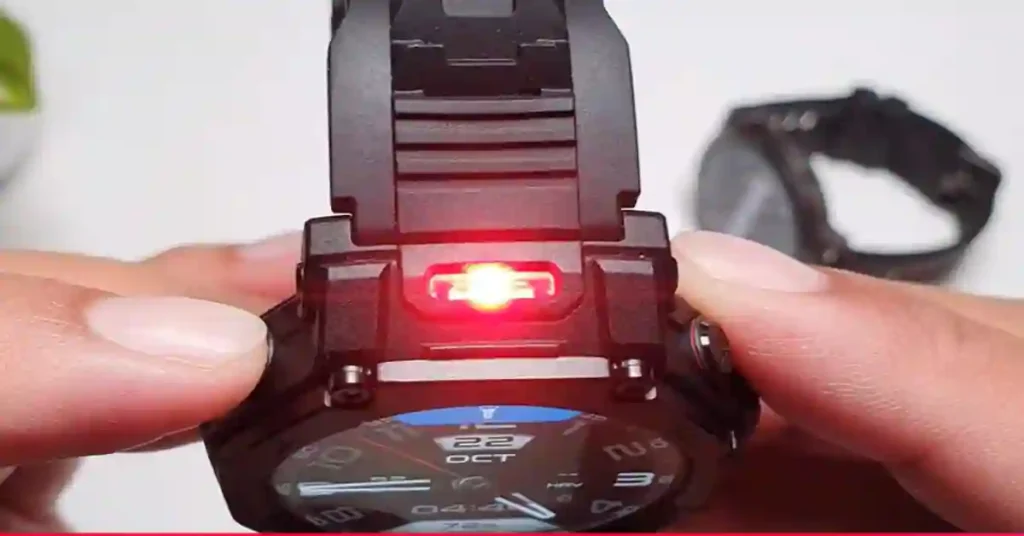
The dual-color LED flashlight sounds like a gimmick until the third time you use it at 5 AM to clip your running pack in the dark, or on a night trail where your phone torch would require you to take a hand off your pole. The white light has three brightness levels.
The red light preserves night vision — genuinely useful for low-light navigation where you do not want to kill your eyes’ adjustment. The SOS strobe mode adds an emergency layer that Garmin does not offer at this price point.
This is one of those features that sounds minor in a spec sheet but becomes part of your regular kit usage very quickly.
Trail Navigation: The Area Where T-Rex 3 Pro Punches Above Its Weight
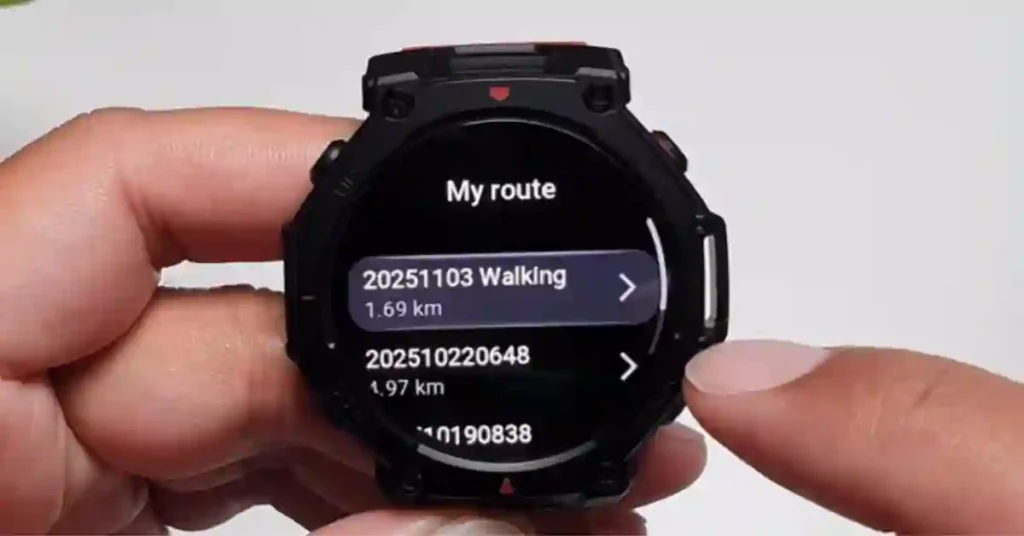
This is where the T-Rex 3 Pro most convincingly justifies its price tag against the Garmin competition. Let me break down each navigation capability that matters on real terrain.
Komoot Integration – Plan a route on Komoot, sync directly to the watch. Works offline once synced. Turn-by-turn cues on the AMOLED display throughout the route.
Route Deviation Alerts – The watch detects when you leave a planned path and alerts you instantly — genuinely life-saving on technical trails with poor visibility.
Contour Maps – Downloadable topographic contour overlays show elevation changes before and during climbs. Free to download from the Zepp app for your region.
Ski Resort Maps – Full downloadable ski resort maps with piste detail and lift info. One of only a handful of sub-$500 watches to offer this.
The Zepp app’s route planning tool lets you import GPX files directly — useful if you use other platforms like AllTrails or Strava routes. You can also create routes from scratch in-app and push them to the watch over Bluetooth before you head out.
Trail runner’s tip: The T-Rex 3 Pro’s route planning also integrates with third-party sensor accessories. Pair it with a Core Body Thermometer for real-time core temperature monitoring during high-altitude hikes — a feature that has historically lived exclusively in much more expensive medical-grade devices.
GPS & Battery Life: Real Numbers for Real Multi-Day Adventures
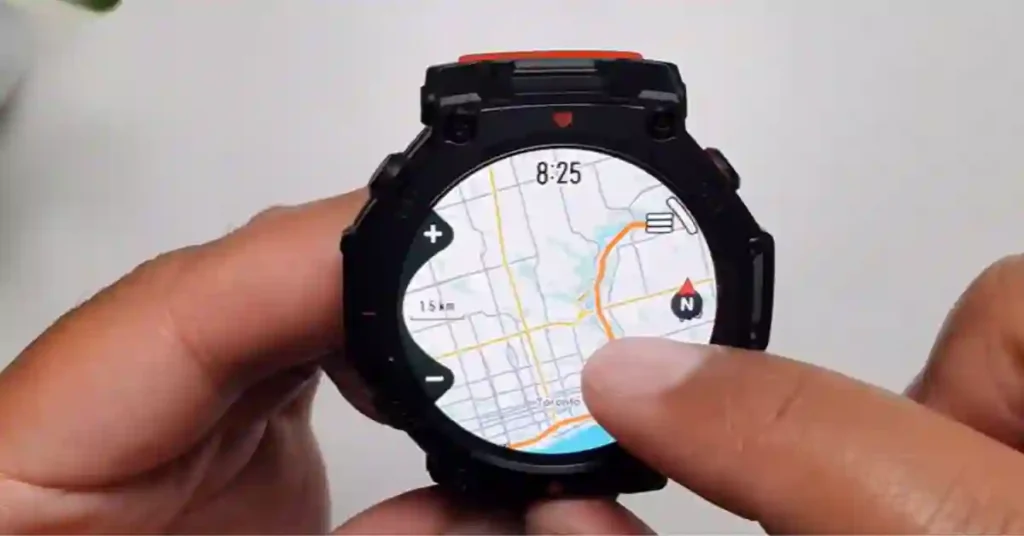
Battery life is where outdoor watch specs frequently lie. “29 hours GPS” sounds great — until you realise that is precision GPS mode, which chews the most power. Here is the full picture of what T-Rex 3 Pro actually delivers:
| GPS Mode | Claimed Battery | Real-World Notes |
|---|---|---|
| Precision GPS (L1+L5) | 29 hours | Best accuracy, best for technical navigation and racing |
| Standard GPS | 48 hours | Good for most trail runs and hikes |
| Long Battery GPS | 114 hours | Reduced sampling rate — still accurate for hiking pace |
| GPS Max / Ultra | 180 hours | Multi-day expeditions. 7.5 days of continuous GPS tracking. |
| Daily Use (no GPS) | 19 days | Tested at 14-16 days with continuous heart rate and sleep tracking on |
The pause-and-resume tracking feature deserves a call-out: if you stop for camp, turn off GPS, and resume the next morning, the T-Rex 3 Pro continues the same activity record rather than starting a new segment. For multi-day thru-hikes this is an enormous quality-of-life feature.
Important — Zepp OS battery bug (June 2026): A significant battery drain issue was reported after recent Zepp OS firmware updates. Some T-Rex 3 (standard model) users saw battery life drop from 25 days to under 10 days overnight. If you notice unexpected drain after an update, see our complete T-Rex 3 battery drain fix guide — it covers sensor loop bugs, watch face glitches, and the step-by-step fix sequence.
Health & Safety Tracking on the Trail
The BioTracker 6.0 sensor array covers the health bases you expect — continuous heart rate, SpO2 (blood oxygen), stress monitoring, and sleep tracking. But two features stand out for outdoor use specifically.
BioCharge: Energy Readiness Tracking
BioCharge is Amazfit’s answer to Garmin’s Body Battery. It analyses HRV, sleep quality, and recent activity load to give you a readiness score before you head out. On multi-day trips where cumulative fatigue matters, this is genuinely useful for pacing decisions.
Real-Time Weather & Allergy Alerts
The T-Rex 3 Pro pulls hyperlocal weather data via the Zepp app and surfaces it directly on the watch face — including temperature, precipitation probability, wind speed, and (unusually) local pollen and air quality alerts. For allergy-sensitive trail runners, this is an unexpectedly thoughtful inclusion that most reviews skip past entirely.
SpO2 at Altitude
Continuous SpO2 monitoring is particularly valuable above 3,000 metres where altitude sickness risk increases. The T-Rex 3 Pro alerts when your blood oxygen drops below a threshold you set — a feature that would have cost you a dedicated pulse oximeter device three years ago.
Smart Features: Honest About the Gaps
The T-Rex 3 Pro has a built-in microphone and speaker — which means you can take phone calls directly on your wrist via Bluetooth. In practice this works reliably enough within arm-range of your phone. It also supports a voice assistant (Siri on iOS, Google Assistant on Android).
With 180+ sports modes, there is tracking for nearly every outdoor activity including fishing (GPS logs your rod positions), dog walking (tracks your route for your pet’s health records), and open water swimming.
But here is where I will be straight with you: the smart ecosystem is where Amazfit still trails Garmin. There is no Spotify. No Apple Music. No offline music playback at all. No NFC contactless payments. No Connect IQ-style third-party app store beyond basic Zepp watch faces. If those features are non-negotiable for you, the T-Rex 3 Pro is not your watch.
Zepp Coach AI: The Zepp Coach training platform deserves a mention — it generates adaptive weekly training plans based on your fitness data and current load. For runners building toward a race, this partially fills the gap left by Garmin’s Training Readiness and Suggested Workouts features.
Amazfit T-Rex 3 Pro vs Garmin: Head-to-Head
The honest comparison is T-Rex 3 Pro ($400) against Garmin Fenix 8 ($900) and Garmin Instinct 3 ($450). Here is where each one wins:
| T-Rex 3 Pro · $400 | Garmin Fenix 8 · $900 | Garmin Instinct 3 · $450 | |
|---|---|---|---|
| Build Material | Titanium + Sapphire | Titanium + Sapphire | Fiber-reinforced polymer |
| LED Flashlight | ✓ Dual-color + SOS | ✓ (Fenix 8 Solar) | Yes |
| Offline Maps | ✓ Topo + Ski | ✓ Full TopoActive | ✓ Limited |
| GPS Endurance | 180 hours max | 89 hours max | 145 hours (GPS Max) |
| Offline Music | ✗ | ✓ Spotify, Amazon Music | ✗ |
| NFC Payments | ✗ | ✓ Garmin Pay | ✗ |
| App Ecosystem | Basic (Zepp store) | Connect IQ (3,000+ apps) | Connect IQ |
| Komoot Integration | ✓ Native | ✓ Native | ✓ Native |
| Bluetooth Calling | ✓ Built-in mic + speaker | ✓ (select models) | ✗ |
| Price | $400 | $900–$1,100 | $450 |
The summary: T-Rex 3 Pro wins on value, GPS endurance, flashlight, and Bluetooth calling. Garmin wins on software ecosystem, offline music, and third-party app support. For pure outdoor performance per dollar, the T-Rex 3 Pro has no serious competition at $400.
Want to dig deeper into the Amazfit vs Garmin question? We cover it in detail in our Comparisons section.
T-Rex 3 Pro vs Standard T-Rex 3: Which One Should You Actually Buy?
The $120 difference between the T-Rex 3 and T-Rex 3 Pro is where most buyers get stuck. Here is how to make the decision quickly:
Choose the T-Rex 3 Pro if: you hike in low-light or at night (flashlight), you need offline maps without a phone signal (remote trails, international trips), you want Bluetooth calling on the trail, or the titanium/sapphire build durability justifies long-term ownership for you.
Choose the standard T-Rex 3 if: you primarily run or cycle on familiar routes with decent phone coverage, you prioritise the longer 27-day advertised battery life over Pro features, or $120 is a meaningful budget decision. The standard T-Rex 3 is an outstanding trail companion at its own price point — it is not a lesser watch, just a different proposition.
Full comparison: We have a dedicated side-by-side breakdown of every spec difference in our T-Rex 3 vs T-Rex 3 Pro comparison guide.
Pros & Cons
✓ What Works Well
- Titanium + sapphire build rivals watches costing 2x the price
- 180-hour GPS endurance is class-leading at this price
- Dual-color LED flashlight with SOS strobe mode
- Komoot + offline maps + ski trails — complete navigation package
- BioCharge energy tracking for training load management
- Bluetooth calling directly on the watch
- Weather + allergy alerts on wrist
- Excellent value vs Garmin Fenix at less than half the price
✗ Where It Falls Short
- No offline music (no Spotify, no local storage playback)
- No NFC payments (Garmin Pay equivalent missing)
- Zepp app ecosystem is limited vs Garmin Connect IQ
- Bulky 48mm case — not suitable as a daily lifestyle watch
- Firmware updates can introduce battery drain bugs (see fix guide)
- 19-day daily battery shorter than standard T-Rex 3’s 27-day
Amazfit T-Rex 3 Pro
Best price currently available on Amazon · Free shipping · Multiple colors
If you’re choosing between Amazfit’s outdoor-focused watches, don’t overlook the Amazfit Balance 3 Titanium vs Stainless Steel comparison, especially if weight and case material matter to you.
Frequently Asked Questions
How Much Does the Amazfit T-Rex 3 Pro Cost?
The T-Rex 3 Pro launches at $399.99 for the 48mm model and $369.99 for the 44mm variant. This makes it significantly less expensive than comparable Garmin Fenix 8 models, which start at $900.
Does the Amazfit T-Rex 3 Pro support music streaming like Spotify?
No. The T-Rex 3 Pro does not support Spotify, Apple Music, or any offline music playback. There is no internal storage for local music files. If offline music is a requirement, the Garmin Fenix 8 supports it — at more than double the price.
Can you make phone calls on the Amazfit T-Rex 3 Pro?
Yes — the T-Rex 3 Pro has a built-in microphone and speaker, allowing you to take and make Bluetooth calls directly from your wrist when your phone is nearby. A voice assistant is also available. This is one of the features that distinguishes it from the standard T-Rex 3.
Is the T-Rex 3 Pro good for skiing and snowboarding?
Yes, and this is one of its strongest use cases. It supports downloadable ski resort maps with piste and lift detail, operates at -30°C, and tracks skiing as a dedicated sports mode with speed, altitude, and slope data. The red LED flashlight is also valuable for early morning lift queues and après-ski.
What is the GPS battery life in actual use?
In precision GPS mode (dual-band L1+L5), the T-Rex 3 Pro lasts approximately 29 hours — good for a marathon, ultra-50k, or full day of technical hiking with continuous tracking. In Long Battery GPS mode, that stretches to 114 hours, and GPS Max mode reaches 180 hours — enough for a week-long thru-hike.
What is the LED flashlight like – is it actually useful?
Yes, the LED Flashlight is more useful than you might expect. The dual-color LED (white + red) has three brightness levels. The red light preserves night vision during low-light navigation — genuinely valuable on technical pre-dawn trails. The SOS strobe mode adds an emergency signalling function that most competitors at this price do not offer at all.
Should I buy the T-Rex 3 Pro or the standard T-Rex 3?
If you need offline maps, a flashlight, Bluetooth calling, and titanium/sapphire durability — get the Pro. If you primarily run or cycle on familiar routes and want the longer 27-day battery at $120 less — the standard T-Rex 3 is excellent value. See our full T-Rex 3 vs T-Rex 3 Pro comparison for the complete breakdown.
Keep Reading
- Comparison Amazfit T-Rex 3 vs T-Rex 3 Pro: Every Difference Explained
- Fix Guide T-Rex 3 Battery Drain After Zepp OS Update — 4-Step Fix
- Rumors & Leaks Amazfit T-Rex 4: Release Date, Specs & Everything We Know
- Buying Guide Best Amazfit Smartwatches 2026: Our Full Ranked List Read article →
- Amazfit Adds Route Planning in Zepp Health App (iOS Only for Now)
- How to Add Offline Music to Amazfit T-Rex 3 Pro (Complete MP3 Upload Guide)
- How to Add GPX Files on Amazfit T-Rex 3 Pro (Step-by-Step Guide)
- Best Amazfit Smartwatch Under $100 in 2026
- Amazfit Cheetah 2 Pro Review: Is It Worth $449.99? (2026)

2 Comments
It does offer NFC payments
Yes, the Amazfit T-Rex 3 Pro has NFC for Zepp Pay, but its contactless payment feature depends on regional availability and support.