


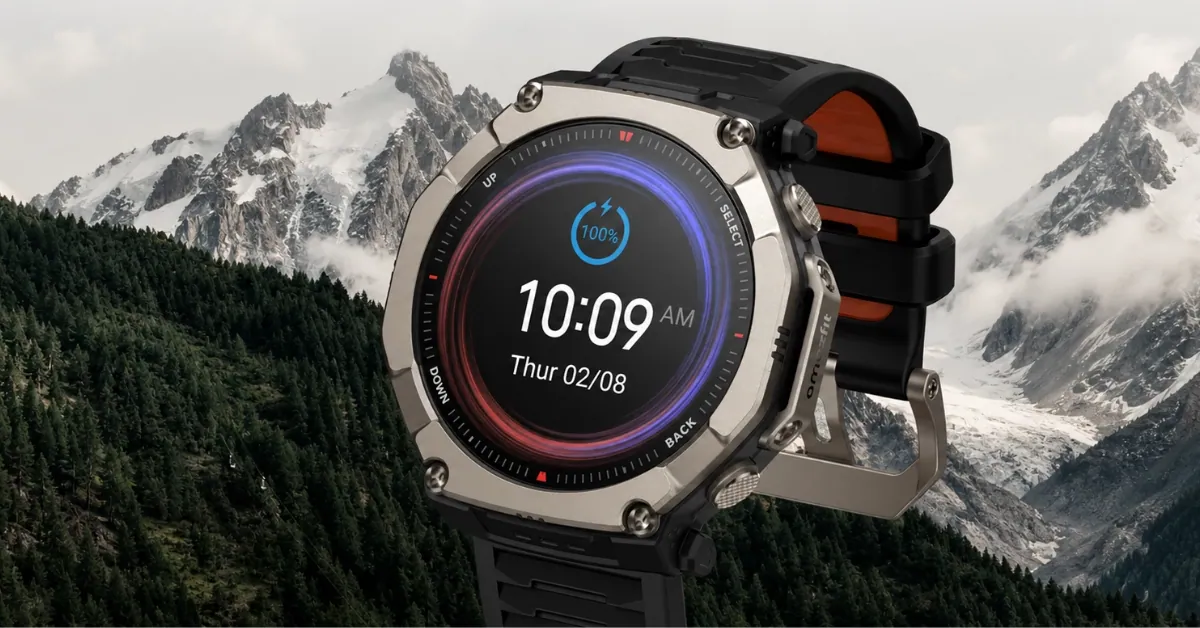
Update, September 22, 2026 — The T-Rex Dual Solar has officially launched. It’s available now at $649.99 with an AMOLED display (not the MIP panel this article predicted below) and a 25-day non-solar battery baseline. For full confirmed specs, pricing, and buying advice, read our complete launch coverage
This post is kept as a record of how the leak unfolded, from the original June code teardown through to regulatory confirmation. Scroll to the bottom for a full “what we got right vs. wrong” breakdown.
Is the Amazfit solar watch real? Yes. The Amazfit T-Rex Dual Solar (model A2570) has cleared regulatory certification in Indonesia, South Korea, Malaysia, and the Eurasian Economic Union as of early August 2026, with Malaysia’s SIRIM filing confirming the name. The name has now been independently confirmed a second time — inside Zepp Health’s own companion app (version 10.7.3), which also revealed a new “Solar Boost Mode” feature.
It’s expected to feature dual solar panels (watch face + case back), a low-power MIP-style display, and could push battery life to 60–100+ days — the dual-panel design was confirmed at launch; the display and battery-range predictions were not (it shipped as AMOLED with a 25-day non-solar baseline; see the “What We Got Right — and Wrong” section below for the full comparison). No official launch date yet, but a debut around IFA 2026 (early September) is plausible. It sits alongside the T-Rex Ultra 2 rather than replacing it, and is not the previously-rumored “T-Rex 4.
Amazfit T-Rex Ultra 2 rugged smartwatch — solar charging now confirmed via regulatory filings as the “T-Rex Dual Solar”
In June 2026, a Zepp Health app teardown revealed active solar-charging code months before any official word from Amazfit. In August 2026, regulatory filings in four countries confirmed the product this article predicted — including its name. Later that same month, a second independent leak — this time from inside the app itself — confirmed the name again and surfaced a new feature. Here’s the full story, from the original leak to the confirmed details.
If you have been following Amazfit for a while, you already know how this works. A new Zepp Health app drops. Someone tears it apart. Hidden strings confirm what is coming next — weeks or months before Zepp Health says a word officially.
It happened with the Active 3 Premium. It happened with the T-Rex Ultra 2. It happened again in June with the Zepp Health app version 10.5.0 — and now, in August, regulatory paperwork has confirmed what that leak was pointing to all along.
Here is the full breakdown: what the code revealed, and what’s now been confirmed.
What Was Found in Zepp Health App 10.5.0
The discovery came from a teardown published by Gadgets & Wearables on June 22, 2026. Three specific code strings told the story.
String 1: solar_intensity
A real-time sensor reading — how much sunlight is currently hitting the watch face. This is not a passive diagnostic. It is a display-facing data field, meaning Zepp Health plans to surface this number directly to users, either on the watch itself or inside the app dashboard.
If you have used a Garmin Fenix Solar, you already know this feature. Garmin shows a solar intensity graph tracking sunlight exposure over the previous hours. Amazfit appears to be building the exact same thing.
String 2: watch_face_input_power
The amount of power being harvested through the watch face display. This confirms the primary solar collection method — a photovoltaic layer integrated into or beneath the watch face, collecting energy as the display faces upward.
This is identical in concept to Garmin’s Power Glass technology, which embeds a transparent solar layer between the display and the outer lens.
String 3: case_back_input_power
This was the most interesting string — and the one that set this apart from anything Garmin currently does.
A separate power input tracked from the back of the case. This could mean a secondary solar panel on the case back itself, an additional charging path through a specialized dock, or a novel energy harvesting approach that no current production smartwatch uses.
If the case back collects solar energy independently of the watch face, the watch could harvest light in two orientations simultaneously — face up on a desk and face down on a wrist both contribute. That would be a genuinely new approach to solar wearables.
This theory is now confirmed by the product name itself. Malaysia’s SIRIM regulatory filing names the device the “T-Rex Dual Solar” — “Dual” almost certainly referring to exactly this two-surface charging setup, watch face and case back working together.
The Older Code Context
This was not the first solar reference in Zepp’s codebase. Earlier app builds already contained a SolarBatteryChargeRecord object with fields including lux, panelType, status, and chargePowerPercent. Those were passive, backend strings.
What changed in 10.5.0 was that the new strings were active and sync-facing — the kind of code you write when you are preparing a feature for real users to see, not internal engineers testing prototypes.
The progression from passive diagnostic strings to active user-facing strings was significant. It marked a shift from “we are experimenting” to “we are preparing to ship” — and that read has now been validated.
App Code Confirms the Name — Again
In late August 2026, a second independent leak arrived — this time from inside Zepp Health’s own software. Version 10.7.3 of the Zepp Health app was found to contain direct mentions of “Amazfit T-Rex Dual Solar,” along with new code parameters referencing a “Solar Boost Mode” feature.
This matters because it’s no longer just a regulatory filing making the case. The name now shows up in two completely separate places — a government certification database in Malaysia, and the company’s own app code. That kind of overlap rarely happens by coincidence.
What “Solar Boost Mode” actually does isn’t confirmed yet, but the name suggests a user-toggleable setting — possibly trading display brightness or GPS accuracy for extended solar-assisted battery life, similar to power-saving modes on Garmin’s Solar watches.
What Display Type Makes Sense
This is the most important technical question — and the answer shapes everything about what this watch actually is.
Note: the section below reflects the reasoning at the time of original reporting. As confirmed at launch, the watch shipped with an AMOLED display, not MIP — see “What We Got Right — and Wrong” below for the full correction.
Solar charging extends battery life meaningfully only when the display itself is power-efficient. On an AMOLED display, solar harvesting adds days at best.
On a MIP transflective display — the technology used in the Garmin Fenix Solar and Instinct Solar — solar can multiply battery life several times over.
Amazfit knows this technology well. The Amazfit Bip S launched back in 2020 with a transflective MIP display and achieved 40 days of battery life with zero solar input. That hardware foundation still exists inside Zepp Health’s engineering team.
A solar watch built on MIP display technology at Amazfit’s current sensor and GPS capability level could realistically target 60 to 100+ days of battery in mixed conditions — directly challenging the Garmin Instinct Solar’s headline specs at a fraction of the price.
Garmin has been moving away from MIP and solar, betting on AMOLED and premium displays. That creates an opening. Amazfit appears to be walking through it.
A visual clue backed this up in July 2026: an unbranded rugged watch with T-Rex styling and a red bezel appeared briefly on Amazfit Spain’s official Instagram account. Its display looked noticeably different from the glossy AMOLED screens on recent T-Rex watches — consistent with a low-power MIP panel, and now widely believed to be this same T-Rex Dual Solar.
Confirmed: The Amazfit T-Rex Dual Solar
As of late August 2026, this is no longer speculation. Regulatory filings in four countries have surfaced model A2570, confirmed by name in Malaysia’s certification database and independently confirmed a second time inside Zepp Health’s own app code — first reported by Gadgets & Wearables.
As of early August 2026, this is no longer speculation. Regulatory filings in four countries have surfaced model A2570, confirmed by name in Malaysia’s certification database.
Model number: A2570
Confirmed marketing name: “T-Rex Dual Solar,” per Malaysia’s SIRIM filing (type approval RDCX/40N/0726/S(26-4227), approved August 3, 2026, certificate holder COMSAT MOBILE COMMUNICATION SDN BHD) — and independently confirmed via Zepp Health app v10.7.3 code strings
New feature name surfaced: “Solar Boost Mode” (exact function not yet confirmed)
Also registered in: Indonesia’s Sertifikasi Indonesia database (certificate 125183/DJID/2026, applicant PT GLOBALTAMA SUKSES MAKMUR), South Korea’s RRA (certified August 4, 2026, applicant Anhui Huami Information Technology Co., Ltd. — Zepp Health’s registered entity), and the Eurasian Economic Union registry
Manufacturing: listed as China and Vietnam
The watch officially launched September 22, 2026 — later than the IFA 2026 window predicted here
One correction to the original reporting below: this is not the “T-Rex 4,” as this article speculated back in June. It’s a standalone, solar-first model sitting alongside the existing T-Rex Ultra 2 — similar to how Garmin treats the Instinct Solar as its own distinct product line rather than a spec bump on an existing model.
How the Original Speculation Held Up
Back in June, with no product name in the leaked code, this article weighed a few candidates for where solar would land first:
- The Amazfit T-Rex Ultra 2 getting a mid-cycle solar refresh — unlikely, since it had only just launched in February 2026 with a strong 30-day battery already.
- A numbered “T-Rex 4” launching with solar built in from day one — this was the article’s best guess, and it turned out to be wrong on the specific naming, though right on the instinct that Zepp Health would want a clean solar story inside the T-Rex family. See our T-Rex 4 tracker for how that story evolved.
- The Amazfit Falcon 2, Amazfit’s higher-end outdoor line, picking up solar as a premium play — still unconfirmed, and now looks less likely as the first solar model given the T-Rex filing.
- An entirely new product line or sub-brand for solar — this is closest to what actually happened. The “T-Rex Dual Solar” keeps the recognizable T-Rex name while functioning as its own distinct model, exactly the kind of clean standalone story this article predicted Zepp Health would want.
Zepp OS Angle — What Solar Means for the Software
This is the part most coverage misses — and as a Zepp OS user, you already know how deeply the app integrates with hardware data.
The solar_intensity string is a real-time sync field. That means the Zepp Health app will display solar data alongside your existing health metrics — HRV, Body Vitality Index, training load, sleep score.
Imagine your morning dashboard showing not just your recovery status but also yesterday’s solar harvesting performance and a projected battery extension based on today’s weather forecast.
Zepp OS 4 already has solid widget customization. A solar intensity widget — showing live lux readings and accumulated solar gain — would be a natural addition to the watch face ecosystem that Amazfit’s community already uses heavily.
The chargePowerPercent field from earlier code also suggests the app will show users what percentage of their daily battery needs are being offset by solar.
That kind of transparency would be new for the category — Garmin shows solar intensity graphs but does not give you a clean “solar covered X% of your day” number.
Amazfit Solar vs Garmin Solar — The Real Comparison
Garmin currently dominates solar with the Fenix 8 Solar and Instinct Solar. Here is an honest comparison of where things stand.
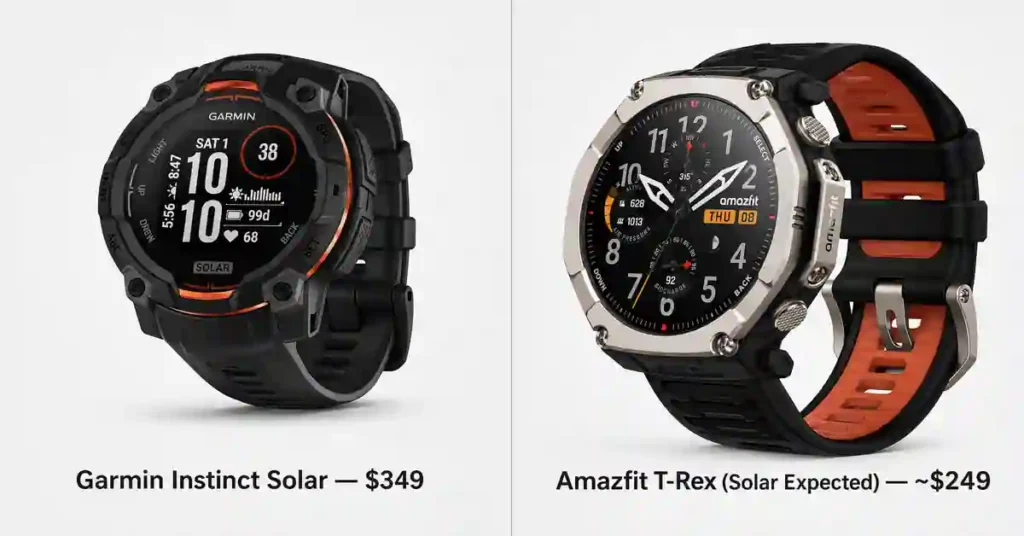
| Garmin Instinct Solar | Garmin Fenix 8 Solar | Amazfit T-Rex Dual Solar (Expected) | |
|---|---|---|---|
| Display | MIP transflective | MIP transflective | MIP likely |
| Solar placement | Watch face | Watch face | Watch face + case back |
| Battery (power save, solar) | Up to 54 days | Up to 107 days | Unknown |
| Multi-band GPS | No | Yes | Likely yes |
| Price | $349 | $849 | $350–$550 estimated |
| Subscription | No | No | No expected |
| Ecosystem | Garmin Connect | Garmin Connect | Zepp Health / Zepp OS |
| Third-party apps | Limited | Limited | Growing — Zepp OS app store |
The price column is where Amazfit wins every time. If the solar performance is even 70% of what Garmin achieves, the value proposition at half the price is compelling for the majority of outdoor users who are not professional athletes.
The ecosystem column is where Zepp Health still trails. Garmin Connect’s training analysis depth, particularly for running and cycling, remains ahead of Zepp Health for serious athletes. But for general outdoor use — hiking, trekking, camping — the gap has narrowed significantly with Zepp OS 4.
Our Amazfit Balance 2 review shows exactly how close Amazfit has come to Garmin-level tracking in real-world tests — solar battery extension on a similarly capable outdoor watch would be the final piece.
Should You Wait for the Amazfit T-Rex Dual Solar
Honest answer — depends on your situation.
Wait if you wanted confirmation this watch was real before committing to anything else: it now is. Regulatory approval across four countries, backed up by a second confirmation inside the app code itself, puts the T-Rex Dual Solar well past prototype stage, with a launch plausibly timed to IFA 2026 in early September.
Wait if you are currently considering a Garmin Instinct Solar or Fenix Solar and the price is the main barrier. An Amazfit solar watch at $350 to $500 with comparable battery extension would change that calculation entirely. A launch within weeks now looks realistic rather than speculative.
Do not wait if you need a new outdoor watch in the next 30 to 60 days. Our Amazfit T-Rex 3 Pro vs Balance 2 comparison shows the two best options available right now — solar extension would be a meaningful upgrade but the current lineup is genuinely good for most outdoor users.
Already own a Helio Strap? A solar-powered outdoor watch could replace your two-device setup entirely. Our Amazfit Helio Strap review explains the current recovery tracking experience and what always-on solar battery would change for 24/7 wear.
Not sure which Amazfit is right for you right now? Our complete Amazfit buying guide ranks every current model — it is the fastest way to decide whether to buy now or wait for solar.
What We Got Right — and Wrong
This article tracked the T-Rex Dual Solar from its first code leak in June 2026 through to its official launch in September. Here’s how the early reporting held up:
✅ Correct:
- The name — “T-Rex Dual Solar” — was confirmed exactly via regulatory filings and app code, months before launch.
- The dual-surface solar concept (watch face + case back) was confirmed exactly.
- It launched as a standalone model alongside the T-Rex Ultra 2, not as a “T-Rex 4” replacement, as this article predicted.
❌ Incorrect:
- Display type: This article argued solar gains only make sense on a low-power MIP display, and predicted MIP for that reason. The watch launched with an AMOLED display, and Amazfit claims meaningful solar-assisted battery gains on it regardless.
- Price: Predicted at $350–550. It launched at $649.99 — closer to Garmin’s premium tier than the budget-friendly positioning this article expected.
- Battery life framing: Predicted 60–100+ days “in mixed conditions.” The confirmed baseline is 25 days with no solar; the 180-day figure requires a stripped-down Outdoor Extreme Mode plus continuous rear-panel solar exposure — a narrower scenario than originally assumed.
For the full confirmed specs and buying guidance, see our launch-day coverage →
Frequently Asked Questions
Is Amazfit releasing a solar smartwatch?
Yes — it has officially launched. The Amazfit T-Rex Dual Solar (model A2570) is available now at $649.99, confirming the name and dual-panel design first spotted in regulatory filings and app code months earlier.
What does “case_back_input_power” mean?
It is a code string tracking power input from the back of the watch case — separate from the watch face solar collection. The confirmed “Dual Solar” name strongly supports the theory that this refers to a secondary solar panel on the case back, working alongside the watch face panel to collect light from two surfaces at once. This has since been confirmed exactly — the launched watch has a solar panel in the case back roughly twice the size of the front panel.
Will this use Zepp OS?
Almost certainly yes. All current Amazfit outdoor watches run Zepp OS. The solar data strings are sync-facing fields that will appear in the Zepp Health app alongside existing health and fitness data.
Which model will get solar first — T-Rex or Falcon?
It’s confirmed to be a T-Rex model — specifically a new standalone model called the T-Rex Dual Solar (A2570), not the T-Rex 4 as originally speculated. It appears to sit alongside the existing T-Rex Ultra 2 rather than replacing it. The Falcon 2 remains a possibility for a future, higher-end solar model, but has not appeared in any regulatory filings so far.
How does this compare to Garmin’s solar technology?
Garmin uses Power Glass — a photovoltaic layer inside the display. Amazfit’s “Dual Solar” naming, combined with the earlier code leak, points to both watch face and case back collection — a technically different approach from Garmin’s face-only system.This has been confirmed at launch: the front display and a larger rear case-back panel both collect solar energy. However, price is no longer Amazfit’s advantage here — at $649.99, it lands in Garmin’s own price territory rather than undercutting it.
When will be T-Rex Dual Solar launch?
It launched September 22, 2026 — a few weeks later than the IFA 2026 window this article had estimated.
What is “Solar Boost Mode”?
A feature name that surfaced in Zepp Health app version 10.7.3, alongside renewed confirmation of the T-Rex Dual Solar name. Its exact function hasn’t been confirmed, but it likely refers to a toggleable mode that extends battery life using solar input, possibly by adjusting display or GPS behavior — similar in concept to power-saving modes on Garmin’s solar watches. At launch, this appears to correspond to what Amazfit shipped as “Outdoor Extreme Mode” — a stripped-down power setting that, combined with continuous rear-panel solar charging, is the basis for Amazfit’s headline 180-day battery claim.
Related Reading on SmartWatchSphere
- Amazfit T-Rex 3 vs T-Rex 3 Pro — Which Should You Buy?
- Best Amazfit Smartwatch in 2026 — Find Yours in 60 Seconds
- Amazfit Active 2 Review 2026: I’ve Worn It for 16 Months — My Honest Take
Sources: Gadgets & Wearables, Notebookcheck, and ChineseSmartwatches.com. Regulatory data: Sertifikasi Indonesia, South Korea RRA, Malaysia SIRIM, EAEU registry.
Written by Sunil Bhatt — SmartWatchSphere, your dedicated source for Amazfit and Zepp OS coverage. Originally published June 24, 2026. Updated SEPT 22, 2026
