



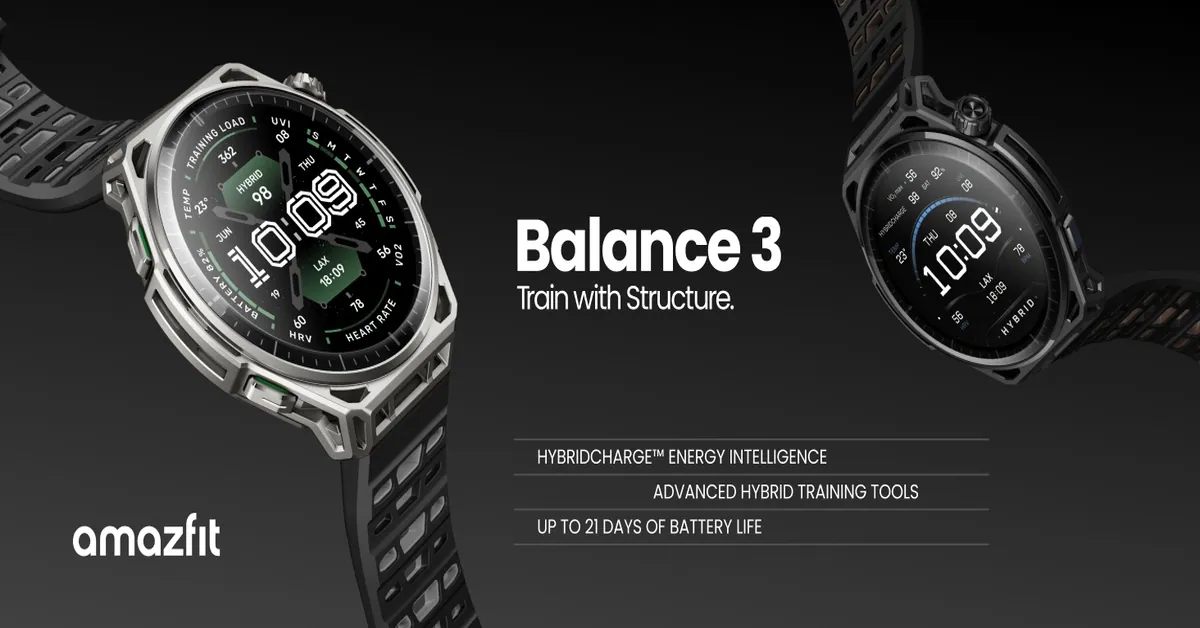
Amazfit has finally started selling the Balance 3 Titanium in the US. It costs $449.99, compared with $369.99 for the stainless-steel version.
That makes the choice fairly interesting because the two watches are much closer than the $80 price gap might suggest.
The Titanium version uses a Grade 5 titanium case and weighs 55g without the strap, compared with 62g for the stainless-steel version.
Apart from that, most of the hardware is shared: both have the same 1.5-inch AMOLED display, sapphire glass, 658mAh battery, 64GB storage, GPS and BioTracker 6.0 sensor system.
So, if you’re looking at both models and wondering where your extra $80 is going, here’s the practical comparison.
Balance 3 Stainless Steel vs Balance 3 Titanium
| Feature | Balance 3 Stainless Steel | Balance 3 Titanium |
|---|---|---|
| US price | $369.99 | $449.99 |
| Case material | Stainless steel + fiber-reinforced polymer | Grade 5 titanium |
| Weight without strap | 62g | 55g |
| Display | 1.5-inch AMOLED | 1.5-inch AMOLED |
| Resolution | 480 × 480 | 480 × 480 |
| Peak brightness | Up to 3,000 nits | Up to 3,000 nits |
| Glass | Sapphire | Sapphire |
| Battery | 658mAh | 658mAh |
| Water resistance | 10 ATM | 10 ATM |
| Storage | 64GB | 64GB |
| GPS | Dual-band, six satellite systems | Dual-band, six satellite systems |
| Health sensor | BioTracker 6.0 | BioTracker 6.0 |
The biggest differences are the case material and weight. The Titanium model is 7g lighter, while the rest of the specification sheet looks very familiar.
My quick take
If you want the better deal, I’d buy the stainless-steel Balance 3.
If you specifically want titanium and a lighter watch, the Titanium version makes sense.
There isn’t a major feature upgrade hiding inside the $449.99 model. You’re mainly paying for the different case construction and lower weight.
That distinction is important because it prevents you from spending the extra $80 expecting a faster or more capable smartwatch.


What does the Titanium version feel like?
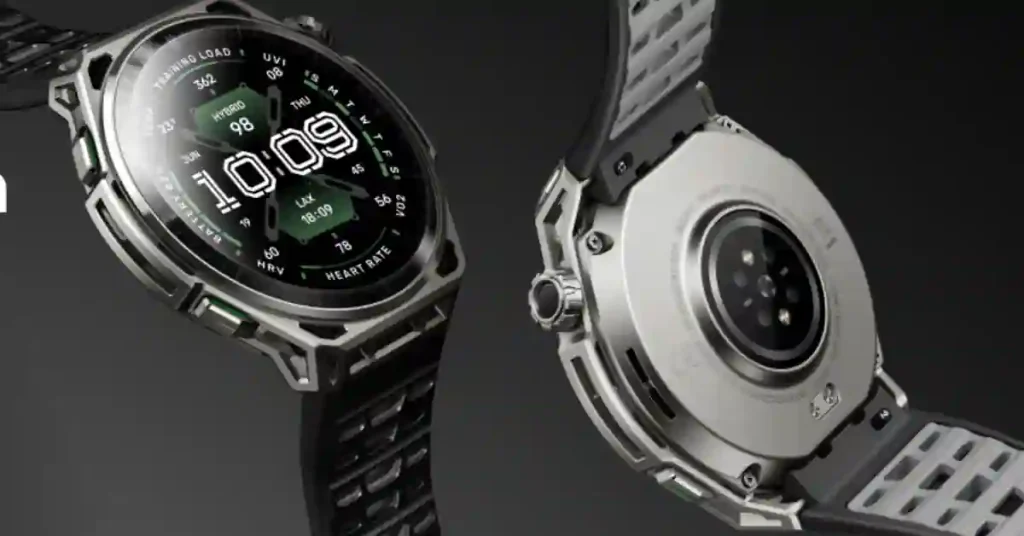
The 55g weight is the most noticeable change on paper.
The regular Balance 3 weighs 62g without its strap, so Titanium cuts 7g from the watch. That’s not enough to make it feel like a completely different watch, but it can be useful if you wear the watch throughout the day and at night.
The Balance 3 is still a fairly substantial smartwatch. Titanium doesn’t make the case smaller.
What it does is take some weight off your wrist while giving you the feel of a more premium metal case.
For someone who sleeps with their smartwatch, wears it through long workouts or simply doesn’t like heavier watches, that’s probably the strongest reason to consider it.
If you’re interested in how Amazfit’s other premium outdoor watches compare, you can also see our Amazfit T-Rex 3 Pro review.
Is Titanium more rugged than stainless steel?
I wouldn’t buy the Titanium model on the assumption that it’s automatically tougher.
Titanium has an excellent strength-to-weight ratio and is highly resistant to corrosion. Those are useful qualities, particularly in a watch that’s going to spend a lot of time on your wrist.
But case material alone doesn’t tell you how well a smartwatch will handle a hard knock or fall. The overall construction matters too.
Amazfit uses sapphire glass on both versions, so the Titanium model doesn’t get a different screen-protection system. The company also describes both titanium and stainless-steel construction as being designed for reliability and daily training use.
So I’d describe Titanium as lighter and more premium, rather than simply “more rugged.”
If durability is your main concern, I wouldn’t pay $80 extra just for the titanium case.
The display is identical
Both versions have a 1.5-inch AMOLED display with a 480 × 480 resolution and up to 3,000 nits of peak brightness. Sapphire glass sits over the display.
That’s a strong setup for an outdoor-focused fitness watch.
You don’t, however, get a better screen by choosing Titanium.
If you’re comparing the two specifically for display quality, the cheaper Balance 3 gives you exactly the same experience.
Battery life hasn’t changed
Both watches use the same 658mAh battery.
Amazfit quotes up to 21 days of typical use, up to 10 days with heavy use and up to seven days with the Always-On Display enabled.
GPS use naturally brings those figures down, with up to 41 hours quoted in Accuracy GPS mode and up to 84 hours in the lower-power GPS mode.
Those are laboratory/manufacturer estimates, so your results will depend on how often you use GPS, workouts, notifications and the display.
For this comparison, though, there’s nothing to choose between them.
The Titanium model doesn’t have a bigger battery or longer quoted battery life.
If you’re interested in getting more battery life from an Amazfit watch, our guide to Amazfit battery-life saving settings covers the settings that can make a difference.
What makes the Balance 3 worth considering?
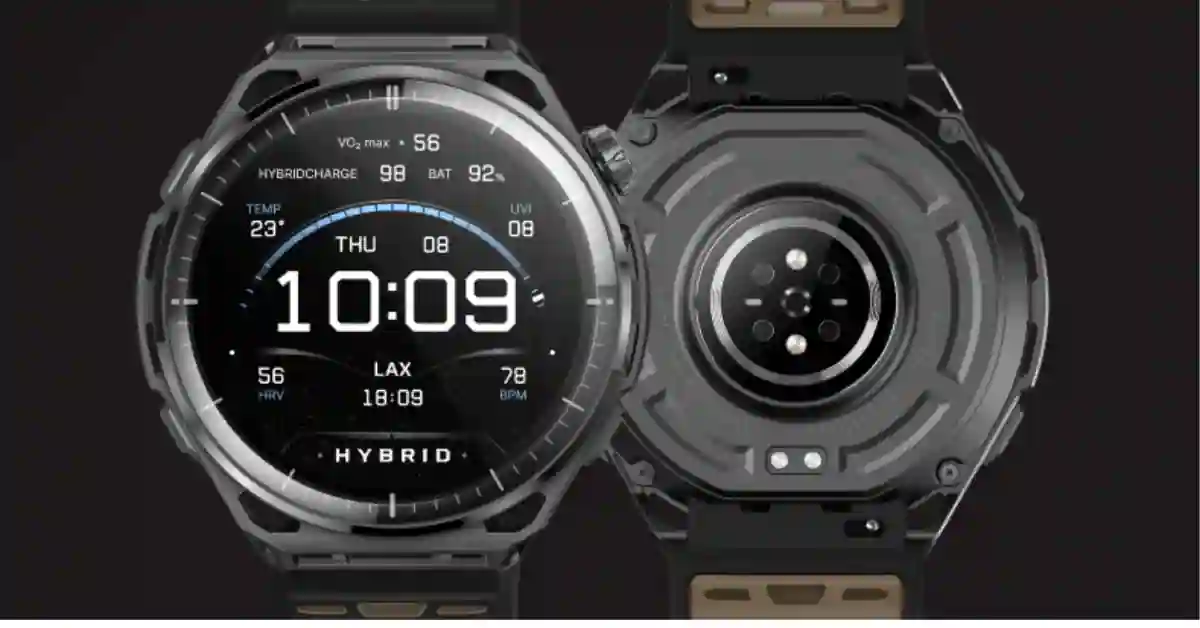
The case isn’t really the reason I’d look at the Balance 3 in the first place.
Its bigger selling point is what Amazfit has packed into the watch.
You get dual-band GPS with six satellite systems, 64GB of storage, offline maps and turn-by-turn navigation. Amazfit also supports route planning and automatic rerouting.
That makes it useful for more than checking notifications.
If you’re a runner, hiker, cyclist or frequent traveller, having maps and navigation on the wrist can be genuinely useful.
The watch is also built around Amazfit’s HybridCharge Energy Intelligence system, which brings together training load, recovery, stress and daily activity. Its training features include metrics such as VO₂ max, training load, training effect and recovery information.
There are also more than 180 sports modes and dedicated HYROX tools, including race mode, training plans, virtual pacing and post-race analysis.
And importantly, you get these features on the regular Balance 3 too.
For a closer look at how Amazfit’s GPS performs in real-world use, see our Amazfit GPS accuracy test.
Health tracking is the same
Both models use Amazfit’s BioTracker 6.0 sensor platform.
The watch tracks things such as heart rate, blood oxygen, stress, sleep and recovery, with additional training metrics for people who exercise regularly.
There’s no separate health-sensor package reserved for Titanium.
So if your reason for upgrading is health or fitness tracking, I’d save the money.
Who should buy the Titanium version?
I’d choose Titanium if the physical watch matters to you as much as what’s inside it.
For example, it makes sense if:
- You prefer titanium watches
- You want the lighter 55g case
- You wear the watch 24/7
- You care about the premium feel of the case
- The additional $80 isn’t a concern
You don’t need to justify that choice by saying Titanium is a better smartwatch.
It’s simply the version with the nicer, lighter case.
Who should buy the stainless-steel version?
This is the one I’d recommend to most people.
For $369.99, you get essentially the same Balance 3 experience: the same display, battery, GPS, storage, health sensors and training platform.
If you’re more interested in what the watch does than what the case is made from, there’s little reason to spend another $80.
The stainless-steel model also keeps the Balance 3 below the $400 mark, which makes it easier to recommend to someone shopping for a feature-packed fitness smartwatch without moving into a higher price bracket.
If you’re still deciding between different Amazfit models, our broader Amazfit smartwatch buying guide can help put the Balance 3 into context.
What about the Balance Ultra?
If you’re already comfortable spending $449.99, it’s worth knowing where the Balance Ultra sits.
Amazfit currently positions it as the flagship member of the Balance family. It also uses Grade 5 titanium and is rated for up to 30 days of battery life. Its US price is $599.99.
That’s another $150, so I wouldn’t automatically jump to it.
If you specifically want the Balance 3 and like the titanium case, the Titanium version is the straightforward choice.
If your budget has already reached $600, though, I’d compare the Balance Ultra before making the final purchase.
Which one would I buy?
I’d buy the stainless-steel Balance 3.
The reason isn’t that the Titanium version is overpriced or poorly made. It’s that I don’t see enough of a functional difference to spend the additional $80 unless I particularly want titanium.
The features I’d care about—battery life, GPS, maps, training, health tracking and the AMOLED display—are already there in the $369.99 model.
If I were wearing the watch every day and really cared about reducing its weight, I could justify the Titanium version.
Otherwise, I’d keep the $80.
My picks
| What you care about | My choice |
|---|---|
| Best value | Balance 3 Stainless Steel |
| Lower weight | Balance 3 Titanium |
| Premium case | Balance 3 Titanium |
| Same core features for less | Balance 3 Stainless Steel |
| Battery life | Either |
| GPS and maps | Either |
| Fitness tracking | Either |
| Health tracking | Either |
| Ruggedness | No clear Titanium advantage |
| 24/7 wear | Titanium |
Final verdict
The Amazfit Balance 3 Titanium is a nice option for people who care about the watch itself—not just the features inside it.
At $449.99, you’re getting a Grade 5 titanium case and a 55g watch instead of the 62g stainless-steel version. The rest of the experience is largely the same.
For most buyers, the $369.99 stainless-steel Balance 3 is the smarter purchase.
I’d spend the extra $80 only if I wanted the lighter weight and titanium construction enough to pay for them.
So the choice is pretty straightforward:
Buy the stainless-steel Balance 3 for value. Buy Titanium because you want Titanium.
That’s really what separates these two models.
Does the Amazfit balance 3 have a SOS mode?
Yes. The Amazfit Balance 3 has an SOS mode built into its flashlight. The watch has a built-in LED flashlight with white and red light options, while the SOS function can flash the light in an international distress-signal pattern.
Just keep in mind that this is a light-based SOS feature, not an emergency-calling system. The Balance 3 doesn’t independently call emergency services or send your location to an emergency contact through this mode.
For runners, hikers and other outdoor users, it’s still a useful addition. If you ever need to attract attention in low-light conditions, having an SOS signal on your wrist is certainly better than having no dedicated signal at all.
Does the Amazfit Balance 3 Have SOS to Call 911?
The Amazfit Balance 3 has an SOS mode, but it isn’t an emergency-calling feature that can call 911.
Its SOS function is tied to the watch’s flashlight and is designed to flash an international SOS distress pattern. That’s useful if you need to signal for help, but it shouldn’t be confused with the emergency-calling systems found on some Apple, Samsung or Huawei watches.
So if your main reason for looking for an SOS smartwatch is being able to press a button and call 911 from the watch, the Balance 3 isn’t the right choice for that requirement.
Bottom line: Balance 3 has SOS signaling, but not 911 emergency calling.
